Community Solar Delivers Affordability Close to Home
PR Newswire
WASHINGTON, July 27, 2026
Case study: How a solar project in suburban Chicago is lowering utility bills, expanding access to renewable energy, and boosting the local economy
WASHINGTON, July 27, 2026 /PRNewswire/ -- Brian Watts works on The Pew Charitable Trusts' energy modernization project.
Dianne has spent decades showing up for her community. A resident of the south Chicago suburb of Calumet City since 1977, the retiree is a familiar face at food drives, library events, and neighborhood outreach programs.
One afternoon a few years ago, a free blood pressure screening brought her to the Village Hall in nearby Lansing. In the lobby, a brightly colored flyer pinned to a bulletin board caught her attention. It was an advertisement for a program promising savings through solar energy.
At first, Dianne assumed that she did not qualify. Living in an apartment building, she had not imagined that solar power was an option for her, given that she was unable to install panels on the building herself. But this program offered another possibility.
"It's just like a farm where food is grown," said Dianne, who preferred not to use her last name. "Only instead of rows and rows of corn, there are rows and rows of solar panels."
The flyer introduced Dianne to community solar, a type of distributed energy resource that allows consumers to benefit from solar energy without installing panels on their roofs. For renters or households unable to afford upfront installation costs, community solar opens access to energy savings that otherwise would be out of reach. Amid rising energy costs across the country, this approach not only supports cleaner energy but provides a pathway to more affordable bills.
A 'win-win' for consumers and the environment
Programs like this community solar site became possible in Illinois after the passage of the Future Energy Jobs Act in 2016, which established programs such as Illinois Solar for All and is helping to reach the goal of generating 40% of the state's energy from renewable sources by 2030. The state initiative was created to help expand access to solar energy for income-eligible households and communities that historically had not benefitted from the clean energy market. By reducing upfront costs and guaranteeing savings for participants, the program uses state-supported incentives to attract private investment in underserved areas.
Through this framework, Reactivate—an Illinois-based company that develops community renewable energy projects benefitting working-class people throughout the country—seeks to meaningfully improve quality of life for communities that host these projects. The 2-megawatt community solar project in Sauk Village, south of Chicago, is known locally as "Torrence" for its location on Torrence Avenue. The project allows residents, including renters like Dianne, to subscribe to locally generated solar energy without the expense of installing their own systems. Torrence prioritizes households with low-to-moderate incomes, meaning those earning at or below 80% of the area median income, while incorporating a smaller number of anchor subscribers to support the project's long-term financial stability.
To drive participation in program sign-ups, Reactivate's subscription management company partnered with community organizations such as the Kenwood Oakland Community Organization and local government offices including the Village of Park Forest and the Housing Authority of Cook County. Participants in these partnerships helped build trust and expand access through outreach efforts such as enrollment events and by assisting residents with the sign-up process.
For Dianne, the appeal of community solar was immediate.
"I wanted to save as soon as I could," she recalled.
After enrolling, Dianne monitored her energy bills—a habit she said she inherited from her late father—carefully tracking the savings she generated through the program. Those savings help with groceries, household supplies, and general maintenance expenses.
"It's a win-win," Dianne said. "It helps the customer and the environment."
Torrence's impact
Dianne is one of approximately 650 subscribers served by the Torrence community solar project, whose beneficiaries are concentrated in south suburban communities such as Calumet City, Park Forest, and Harvey. Customers, among them many renters and people of color, fall into a range of income brackets, with 91% earning less than $50,000 annually:
- 44% earn less than $20,000 per year.
- 47% earn between $20,000 and less than $50,000.
- 9% earn between $50,000 and less than $100,000.
Because the Torrence project predominantly serves communities with low-to-moderate household incomes, it plays an important role in addressing energy burden, a metric that defines the percentage of income a household spends on electricity bills. On average, low-income households have an energy burden of 6%, which is three times higher than that of other households. When a household spends 6% or more of its income on electricity, it is considered to have a high energy burden.
Through discounted electricity rates, subscribers receive guaranteed savings on their energy bills. During its first year of operation, from October 2024 through October 2025, the Torrence project delivered an estimated $186,000 in total customer savings.
Operationally, Torrence has exceeded performance expectations. The system maintains approximately 99.5% availability—the percentage of time the system is operational and capable of producing power—and operates more efficiently than a typical solar project, reflecting consistent and reliable clean energy generation.
But the project's impact extends beyond electricity generation and savings.
More than just electrons
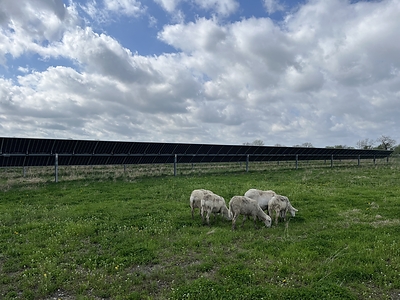
"We had no idea at the time that being experts in sheep production and commercial mowing would create such a unique opportunity for us in solar grazing," said Brooke Watson, vice president of business development at Watson Farms—Illinois Solar Grazing & Mowing, a business that provides services from expertise in livestock production to commercial mowing.
Brooke and her husband, Chauncey Watson IV, own and operate Watson Farms, a seventh-generation family farm that traditionally specialized in lamb, beef, poultry, hay, and straw production. In 2024, Watson Farms became the third solar grazing company in Illinois to put "hooves on the ground," with Torrence serving as the first site where its sheep provided vegetation maintenance by grazing among solar panels. Today, the company manages roughly 600 sheep across 20 solar locations, performing work that might otherwise have been handled by landscapers and making the business one of the largest solar grazing operations in the state.
"It's a business that made sense on a lot of levels," Brooke Watson said, noting the difficulties facing small family farms that rely heavily on traditional row crops. "One of the challenges in agriculture is that you constantly have to get creative with your revenue streams."
Watson credits her husband and father-in-law with expanding into sheep production and commercial mowing nearly 30 years ago. This experience ultimately led Watson Farms to partner with Reactivate for solar grazing.
"There's a perception in a strong agricultural state like Illinois that there is no agriculture in Chicago," said Watson, who was born and raised in the city's northern suburbs. Watson Farms, through its partnership with Reactivate's solar farm, is changing that viewpoint. "We're really proud and think it's special."
Growing through partnerships
The Torrence community solar site has also generated broader economic opportunities. The project has created 30 to 40 jobs in development, construction, and operations, and workforce training initiatives are helping local residents enter the growing clean energy industry.
Through Building Equity in Solar Training, Reactivate's workforce training program, participants receive classroom instruction and hands-on technical experience designed to prepare them for careers in solar energy. Graduates are then connected with employment opportunities in the clean energy sector.
Development and construction activities—including more than $3.5 million in local and regional supplier spending and the generation of more than $1 million over the next 20 years from property taxes and lease payments—have further supported the local economy.
In 2024, Torrence received the U.S. Energy Department's Community Power Accelerator Prize, recognizing the project's contributions to equitable energy access and local economic development. Over the lifetime of the Torrence community solar project, participating households are expected to save approximately 50% on their electricity costs.
For Dianne, those savings are already making a difference.
In May, unseasonably warm temperatures hit the Chicago area, sending highs above 85 degrees Fahrenheit.
"It got hot, pretty hot," she said, recalling that she switched on her window air conditioning unit earlier than usual.
In the past, turning on the air conditioner so early in the season would have caused her to worry about a spike in her electric bill. Now, even on Chicago's hottest summer days and coldest winter nights, Dianne knows she can expect lower utility bills.
Torrence's success demonstrates how community solar programs, supported through state policy and strengthened by local partnerships, can expand access to affordable clean energy while generating lasting economic and community benefits.
After signing up for the community solar program, Dianne said she was surprised to see the many little black panels along the side of the road while driving on Torrence Avenue—and she was pleased to realize that they made up the solar farm to which she subscribed.
"For people who are not homeowners, you don't have to worry about installing a panel," Dianne said. "I think the word should get out," she remarked, "that it's a good thing."
For more information, visit Energy Modernization | The Pew Charitable Trusts (pewtrusts.org)
Contact: Matt Herbert, officer, mherbert@pewtrusts.org, 605-759-8911
 View original content to download multimedia:https://www.prnewswire.com/news-releases/community-solar-delivers-affordability-close-to-home-302835633.html
SOURCE The Pew Charitable Trusts